
Major enterprises and corporations in the Kingdom of Saudi Arabia rely on their digital assets to build a trusted identity and seamlessly manage their daily operations. An enterprise custom cms represents the backbone for all software and media operations, providing absolute flexibility to control data, documents, and media, while avoiding software glitches and slowness resulting from traditional open-source solutions.
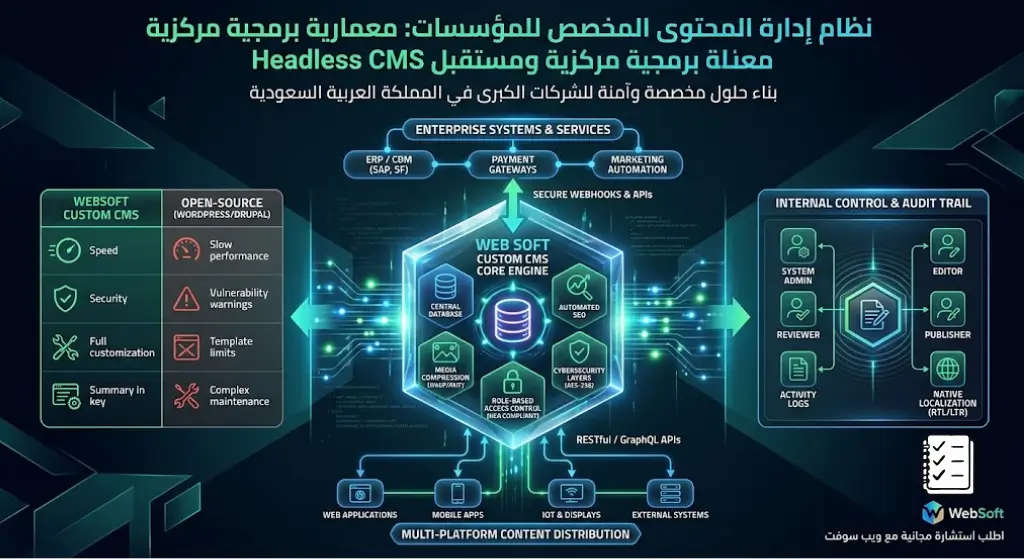
Choosing an enterprise custom cms provides a centralized software environment that allows large organizations to create, edit, automate, and organize digital content without manually modifying the source code, backed by full security control, exceptional server response speeds, and flexible integration via RESTful APIs with all enterprise systems.
Technical Criteria for Selecting an Enterprise Custom CMS
Selecting an enterprise custom cms that meets the expectations of major sectors requires a comprehensive study of its software and engineering features, as this decision directly impacts team efficiency, digital security, and search engine visibility speed:
🔹 Code Architecture and Server Performance: Professional performance demands clean programming that achieves a time-to-first-byte (TTFB) of less than 100 milliseconds and employs advanced server and database-level caching systems.
🔹 Scalability and Adaptability: Supporting thousands of concurrent requests per second without any drop in speed or system downtime.
🔹 Digital Asset Management Flexibility: An integrated infrastructure to automatically upload, process, and compress media, converting them to modern formats such as WebP and AVIF.
🔹 Multi-Level Permission Management: Providing strict frameworks to control permissions based on job roles (Role-Based Access Control).
Technical Comparison: Custom Solutions vs. Open-Source Systems
Major companies and organizations always face a critical trade-off when adopting an enterprise custom cms compared to ready-made solutions like WordPress or Drupal. The following table highlights the core architectural and operational differences between the two options:
| Technical Aspect | Enterprise Custom CMS (WebSoft) | Open-Source Systems (WordPress / Drupal) |
|---|---|---|
| Performance & Response Speed | Ultra-lightweight, instant processing, code designed exclusively for required functions. | Slow due to excessive unnecessary scripts and plugins. |
| Cybersecurity Level | Dedicated isolated environment, strict encryption, native vulnerability protection. | Continuous exposure to security vulnerabilities in open-source plugins and libraries. |
| Customization & Development | Complete freedom in data architecture and feature engineering tailored to business needs. | Restricted by specific templates and frameworks requiring workarounds to modify. |
| Sustainability Cost | One-time initial investment with long-term operational stability and low maintenance. | Escalating costs for maintenance, plugin updates, and bug fixes. |
| API Integration | Built-in RESTful / GraphQL APIs customized for instant connectivity. | Complex and requires extra software layers that may slow down output. |
| System Updates | Seamless updates that do not impact site stability or existing functionality. | Frequent updates often causing plugin conflicts and site downtime. |
| 💻 Request Free Consultation | 💬 Contact via WhatsApp |
Headless CMS Architecture and the Future of Distributed Content Management
Implementing a Headless CMS architecture within an enterprise custom cms provides complete separation between the backend data management layer and the frontend presentation layer, delivering content seamlessly across all screens and devices via secure APIs.
This distributed architecture empowers organizations to publish content once and instantly distribute it across multiple channels, such as websites, mobile applications, smart displays, and customer service systems, while guaranteeing complete backend database protection.
Internal Engineering for Permission Management and Structural Control
The efficiency of digital operations depends on control panel precision, where engineering an enterprise custom cms by WebSoft ensures an advanced control structure:
🔹 Role-Based Access Control (RBAC): Defining granular roles (System Administrator, Editor, Reviewer, Publisher) while restricting each user’s access to specified sections.
🔹 Audit Trail & Activity Logs: Recording all performed operations—creation, modification, or deletion—along with timestamping and user IP tracking.
🔹 Automated Publishing & Review Workflows: Automating content approval pipelines through distinct stages to guarantee quality before public publishing.
🔹 Native Multi-Language Support: Full built-in support for managing multi-language content with automatic handling of text directionalities (RTL/LTR).
Cybersecurity & Compliance according to NCA Standards
Cybersecurity is the core pillar when programming and developing an enterprise custom cms. WebSoft applies strict security frameworks ensuring compliance with National Cybersecurity Authority (NCA) controls and OWASP Top 10 recommendations:
1. Data Encryption: Using advanced encryption algorithms such as AES-256 for data at rest and TLS 1.3 for data in transit across the network.
2. Multi-Factor Authentication (MFA): Enforcing additional verification methods to access enterprise control panels.
3. Direct Vulnerability Prevention: Building native protection layers to prevent SQL Injection, Cross-Site Scripting (XSS), and CSRF attacks.
4. Automated Backups: Generating periodic encrypted database and file backups with one-click instant recovery capabilities.
SEO Automation in Custom Systems
Meeting top ranking requirements and covering GEO and AI criteria demands built-in automation tools inside an enterprise custom cms:
🔹 Schema Markup Generation: Automatically generating JSON-LD code for every content type (articles, products, services, FAQs).
🔹 Sitemap & Redirect Management: Real-time XML Sitemaps updates with automatic 301 Redirect handling whenever URLs change.
🔹 Complete Meta Tags Control: Customizing SEO titles, descriptions, and Open Graph tags for social networks with extreme accuracy.
🔹 Smart Image Compression & Adaptation: Instant processing of uploaded images with automatic Alt Text generation for effective indexing.
API Software Integration & Expanding the Digital Ecosystem
Custom software is defined by its ability to achieve seamless compatibility and integration with existing enterprise software without altering the underlying infrastructure:
(SAP, SF)
Gateways
Automation
An enterprise custom cms developed by WebSoft enables direct integration with Customer Relationship Management (CRM) tools, Enterprise Resource Planning systems (ERP like SAP and Oracle), payment gateways, and automated marketing publishing platforms via custom Webhooks.
Architectural Mistakes Companies Make When Selecting a CMS and How to Avoid Their Costs
Ill-advised technical choices lead to exorbitant operational costs and digital bottlenecks. Key architectural flaws and their structural remedies include:
🔹 Relying on External Plugins for Core Functions: Adding dozens of plugins causes server lag and security holes. WebSoft solves this by building all features within the system’s core engine.
🔹 Neglecting Database Schema Planning: Unoptimized queries cause performance collapse as content expands. WebSoft builds custom relational and non-relational databases structured for data growth.
🔹 Ignoring Core Web Vitals During Development: Focusing solely on design while ignoring LCP and CLS metrics degrades search engine rankings. Custom code guarantees fast response meeting top technical standards.
System Development & Testing Life Cycle at WebSoft
WebSoft adopts precise engineering methodologies to build and develop custom software solutions to ensure maximum quality and performance:
1. Requirements Gathering & Analysis: Studying current workflows and identifying needs for editors, administrators, and technical support teams.
2. System Architecture Design: Database design, API route mapping, and encryption/security framework planning.
3. Custom Development: Source code development following modern standards alongside custom control panel engineering.
4. Security & Performance QA (QA & Penetration Testing): Conducting penetration and stress testing to ensure stability under heavy traffic.
5. Migration & Training: Migrating legacy data without disrupting SEO rankings and training organization personnel to operate the system.
Why is WebSoft the Certified Software Partner in Saudi Arabia?
WebSoft possesses extensive experience in building and developing complex software solutions for enterprise, government, and private sectors in KSA:
🔹 Custom Software Expertise: Systems engineered completely from scratch according to your specifications without relying on pre-made templates.
🔹 Complete Cybersecurity Compliance: Adherence to national and international standards for data encryption and security.
🔹 Direct Technical Support & Ongoing Updates: Dedicated in-country technical teams providing 24/7 maintenance and rapid response.
🔹 Superior Performance & SEO Optimization: Software architecture that secures top search engine positions and exceptional speed ratings.
Frequently Asked Questions
What is an Enterprise Custom CMS and why do large companies prefer it?
It is a system built specifically to meet the needs of a specific organization without relying on open-source templates or plugins. Enterprises prefer it for high speed, total security, and unlimited scalability.
How does Headless CMS differ from a traditional CMS?
Headless CMS decouples the front-end display from the back-end data management panel, serving content via APIs across all platforms with equal performance.
Does WebSoft CMS support full Arabic localization?
Yes, all systems are built with native support for Arabic and RTL directionality, featuring an advanced and flexible rich text editor.
How does a custom CMS improve Search Engine Optimization (SEO)?
The system provides clean code free of software bloat, ultra-fast load times, automated Schema and XML Sitemaps generation, and complete URL customization.
What security standards are applied to safeguard data?
We apply top cybersecurity standards such as AES-256 encryption, SQL Injection and XSS protection, Multi-Factor Authentication (MFA), and compliance with NCA guidelines.
Can a custom CMS integrate with Enterprise CRM/ERP systems?
Absolutely. The system is engineered to support full integration via RESTful API and GraphQL to connect data directly with platforms like SAP, Salesforce, and Oracle.
How long does it take to develop a custom CMS with WebSoft?
Development typically ranges between 4 to 7 weeks depending on project scope, required integrations, and software features defined during the analysis phase.
How is data migrated from an old platform to the new system?
We execute precise Data Migration & ETL operations to transfer text and media assets while preserving existing URL structures and SEO rankings.
Conclusion
Amid rapid digital transformation in the Kingdom of Saudi Arabia, an enterprise custom cms is no longer just a publishing tool, but a strategic software asset defining enterprise growth speed, data security, and search engine competitiveness. Moving away from bloated open-source software toward a secure custom core built to NCA standards is the decisive step for innovative organizations.
| 💻 Request Free Consultation | 💬 Contact via WhatsApp |